
The Story of Villa Kourkoulios and the Village of Champatha
Updated: Sep 24
Hidden among the foothills of Crete's White Mountains, the tiny hamlet of Champatha (Χάμπαθα) is easy to miss. Today it is a peaceful hamlet of old stone houses surrounded by olive groves and woodland, but its history stretches back several centuries.
Like many of the small mountain settlements of western Crete, Champatha was almost certainly established centuries before most of the surviving houses were built. Although little has been written about the village in English, historical records show that it was already an established settlement during the Venetian occupation of Crete.
The earliest known documentary references date to the late sixteenth century. The Venetian geographer Francesco Barozzi recorded the village in 1577 under the name Ghabatha. It appeared again in the 1583 census of Kastrofylakas, and in 1630 the Venetian engineer Francesco Basilicata listed it as Chabata. These records demonstrate that Champatha has existed for at least 450 years and almost certainly originated during the Byzantine period, if not earlier.
Even the origin of the village's name remains uncertain. The Cretan historian Stergios Spanakis, whose work on the island's place names remains authoritative, suggested that Champatha derives from the word χάμπασα, describing rocky or barren ground. Others have proposed that it evolved from λάμπαθο, the name of a broad-leaved wild plant once common in the area. Like many ancient Cretan place names, its true origin has probably been lost to time.
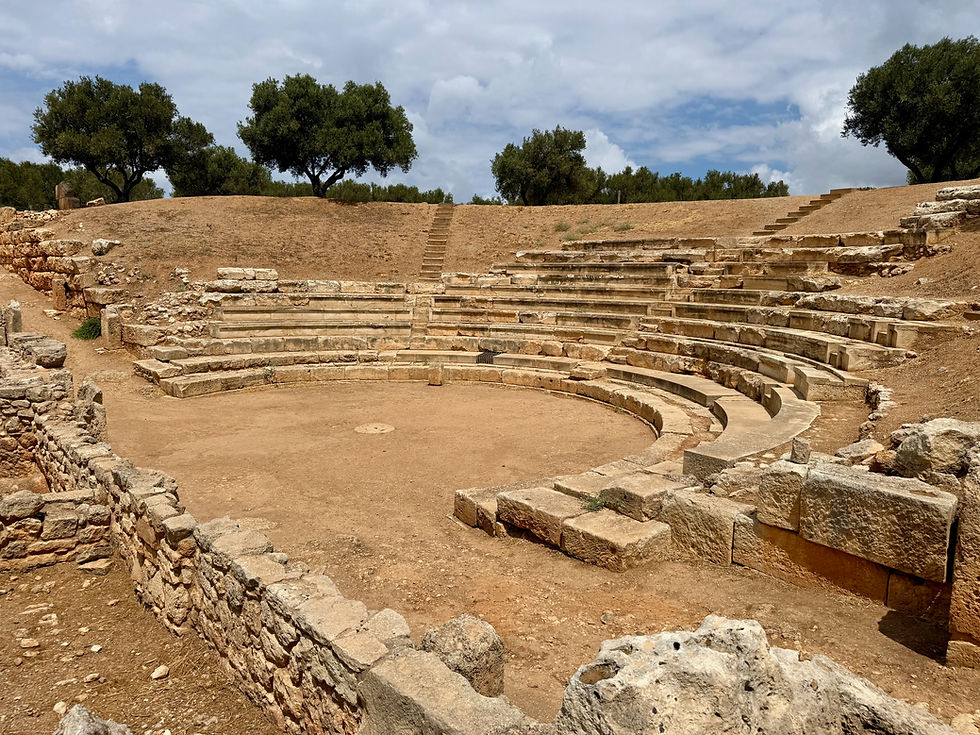
Its position is no accident. Perched on a hillside overlooking fertile valleys, close to natural springs and ancient routes through Apokoronas, the village occupies an ideal location for farming. Archaeological sites at nearby Maza, Stylos and Azoires show that people have lived in this landscape continuously since Minoan, Roman and Byzantine times. Although no direct evidence links modern Champatha to these earlier settlements, it is likely that generations of farmers have cultivated these same hillsides for many centuries.
A Chapel Older Than the Village Houses

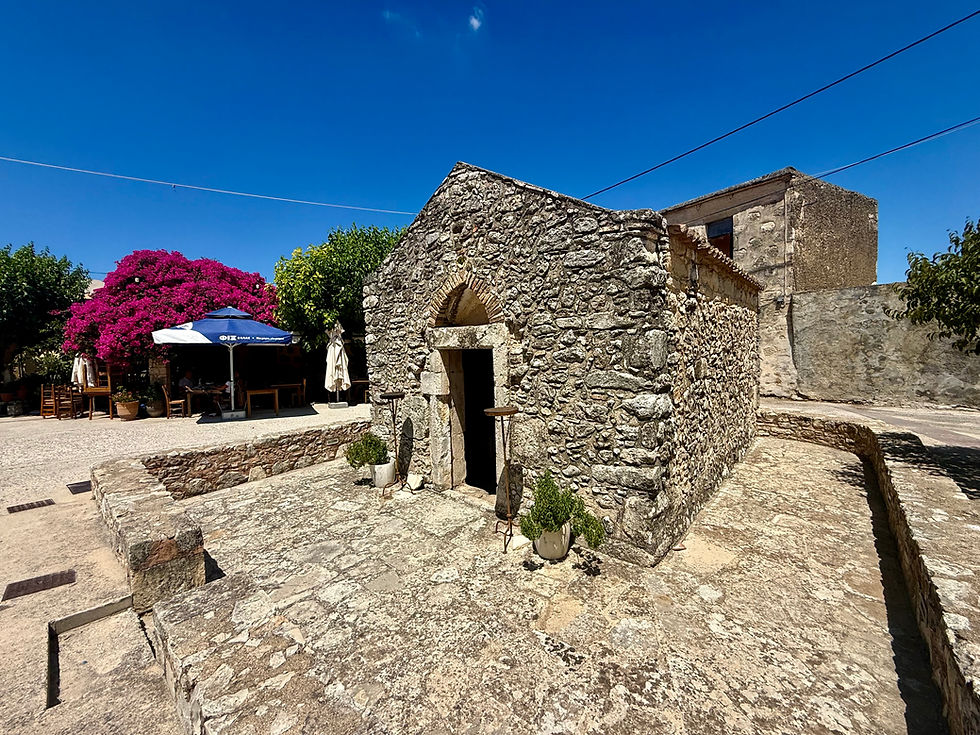
Leaving the villa and turning right along the track, you eventually come to one of Champatha's oldest surviving buildings, the Chapel of Agios Georgios (St George).
Now serving as the village cemetery church, it is thought to date from the late medieval period, probably the fifteenth century, although it may be older. Built as a simple single-aisled barrel-vaulted church, its plain exterior gives little hint of what lies inside.
The interior walls are covered with remarkable Byzantine frescoes. Although time, moisture and later plastering have damaged parts of the paintings, many scenes remain beautifully preserved, providing a rare glimpse into the religious art of medieval Crete.
The church is dedicated to Agios Georgios Methystis ("St George the Drunkard"), one of the more unusual dedications found in western Crete. Despite the name, it has nothing to do with drunkenness. The feast of Agios Georgios Methystis falls in early November, traditionally marking the first tasting of the new wine after the autumn harvest. Many historians believe this Christian celebration absorbed much older agricultural festivals associated with the grape harvest and the island's long tradition of wine-making.
Village Life
Along the track to the Chapel of St George, you descend through what was once the heart of Champatha. Today many of the houses stand empty or in ruins, but only a few generations ago this would have been a busy farming community filled with families, livestock and the sounds of daily village life.
Near the parking area are the remains of an aloni (αλώνι), the circular stone threshing floor that once played a vital role in the annual wheat harvest.


After the grain had been cut, a donkey would pull a heavy wooden threshing sledge, known as a volosiros, fitted with sharp stones or metal blades. As it circled the threshing floor, the sledge broke apart the ears of wheat.
The site of the aloni was carefully chosen to catch the prevailing winds blowing up the valley. Once threshing was complete, farmers tossed the mixture of grain and chaff into the air using large wooden forks. The breeze carried away the lighter chaff while the heavier wheat fell back onto the stone floor, ready to be collected.
These ingenious structures were once found throughout Crete and remind us how dependent village life was upon the rhythm of the seasons.
The same area also features the remains of what is probably a communal wine press.
The Story of Villa Kourkoulios
Villa Kourkoulios was purchased in 2026 by Nick and Amy from the Greek owner, Antonis, whose family had owned the property since around 1880.
According to family history, the house was originally built by Antonis' great-grandmother at a time when matriarchal traditions remained strong in rural Crete. Property, especially land and family homes, often passed through the female line as part of the dowry system. While men frequently spent long periods away farming, herding livestock or trading, women managed the household, land and finances. The family home—the spiti—formed the permanent centre of family life and was commonly inherited by daughters.
In the 1930s, Antonis' grandparents, Irini and Antonis Boutsarakis, began their married life in the house. Shortly afterwards this Antonis was called up to serve in the Greek Army during the Second World War.

Following the German invasion of Crete in 1941, he returned home and became involved in the Cretan Resistance (Κρητική Αντίσταση). According to family tradition, he would occasionally disappear into the surrounding hills to join resistance groups operating against the occupying forces.
A water cistern once stood on roughly the site of today's swimming pool. According to the family, it concealed a cache of weapons used by the resistance. The rusted remains of Antonis' revolver can still be found among the villa's possessions—a small but powerful reminder of those dangerous years.
After the war, Antonis and Irini raised their four children here: three daughters and one son, George Boutsarakis, the father of the present-day Antonis.
In 1974 the family moved to Chania for work and the house gradually fell into disuse before being severely damaged by fire around 1985.
Fortunately, the house was not lost forever.
In 2008 Antonis began a painstaking restoration, using traditional materials and techniques wherever possible. The roof structure was rebuilt using Cretan cedar, with traditional timber trusses designed to improve earthquake resistance. Care was taken to preserve as much of the original fabric as possible, and if you look closely in the kitchen and dining room you can still see soot stains left by the fire on some of the original stonework.
The restoration also added an upstairs bathroom and the terrace bedroom, both ingeniously accessed through what had originally been an upstairs window. The blue four-poster bedroom remains the original family room.
The smaller section of the building, now known as the Garden Room, once sheltered the family's donkey and cow, and was also used to store olive oil and wine.
Outside, many reminders of the villa's agricultural past remain. The large stone basin beside the barbecue originally served as the family's washing trough before running water reached the village and later became a bath for young children. Around the garden are fragments of millstones and carved stones recovered during restoration. Built into one corner of the house is a stone with a circular hole through it, where the family's donkey would once have been tethered.
Even the villa's name has its own story. Kourkoulios is not a standard Greek surname but a family nickname inherited from Antonis' grandfather, preserving another small piece of the village's local history.
Today, Villa Kourkoulios forms part of a village story that spans well over four centuries. From medieval frescoes and Venetian records to wartime resistance and careful restoration, the house and the village together offer a rare opportunity to experience a quieter side of Crete—one where the landscape, traditions and memories of generations still shape everyday life.
Sources
Barozzi, F. (1577); Census of Kastrofylakas (1583); Basilicata, F. (1630); Stergios Spanakis, Πόλεις και Χωριά της Κρήτης (Cities and Villages of Crete); local history and traditions recorded by the Boutsarakis family.
Comments