
Aptera: Three Thousand Years Above Souda Bay
Updated: Sep 24
Discovering Ancient Aptera
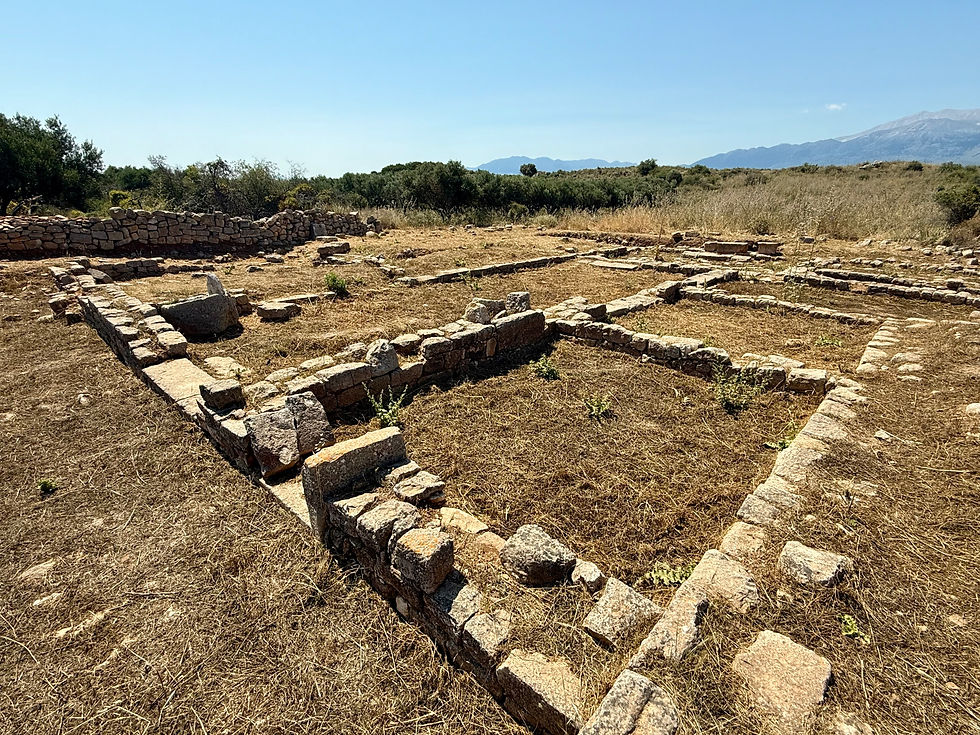
Just a short drive from Villa Kourkoulios (30 minutes), overlooking Souda Bay, are the extensive remains of one of ancient Crete’s most important city-states. Aptera is easy to reach from the national road and makes an excellent half-day excursion from the villa.
But Aptera is not simply a collection of ancient ruins. The site tells the story of a city that was wealthy, ambitious and strategically important, and which survived for more than a thousand years. Its remains range from 4th century BC fortifications and a theatre to Roman houses, baths and enormous water cisterns, while a Venetian-era monastery and an Ottoman fortress remind us that the hill continued to be important long after the ancient city had disappeared.
Perhaps the most interesting thing about Aptera is that you can begin to appreciate its scale and importance even before you reach the ticket office.
The Road to Aptera
As you leave the modern village of Aptera and follow the road towards the archaeological site, keep an eye out for the remains of the ancient city walls.
The walls originally ran for around 3.5 km around the settlement, built during the fourth century BC to follow the natural contours of the hill — the steep slopes doing part of the defensive work themselves. Aptera occupied an exceptionally strategic position above Souda Bay, with extensive views across the surrounding countryside and out to sea.
The city's location was no accident. Ancient writers tell us that Aptera controlled two harbours: Minoa, near modern Marathi, and Kissamos, in the area between Kalami and Kalyves. From here Aptera could therefore play an important role in the movement of goods and people around western Crete.
The Ancient Gate
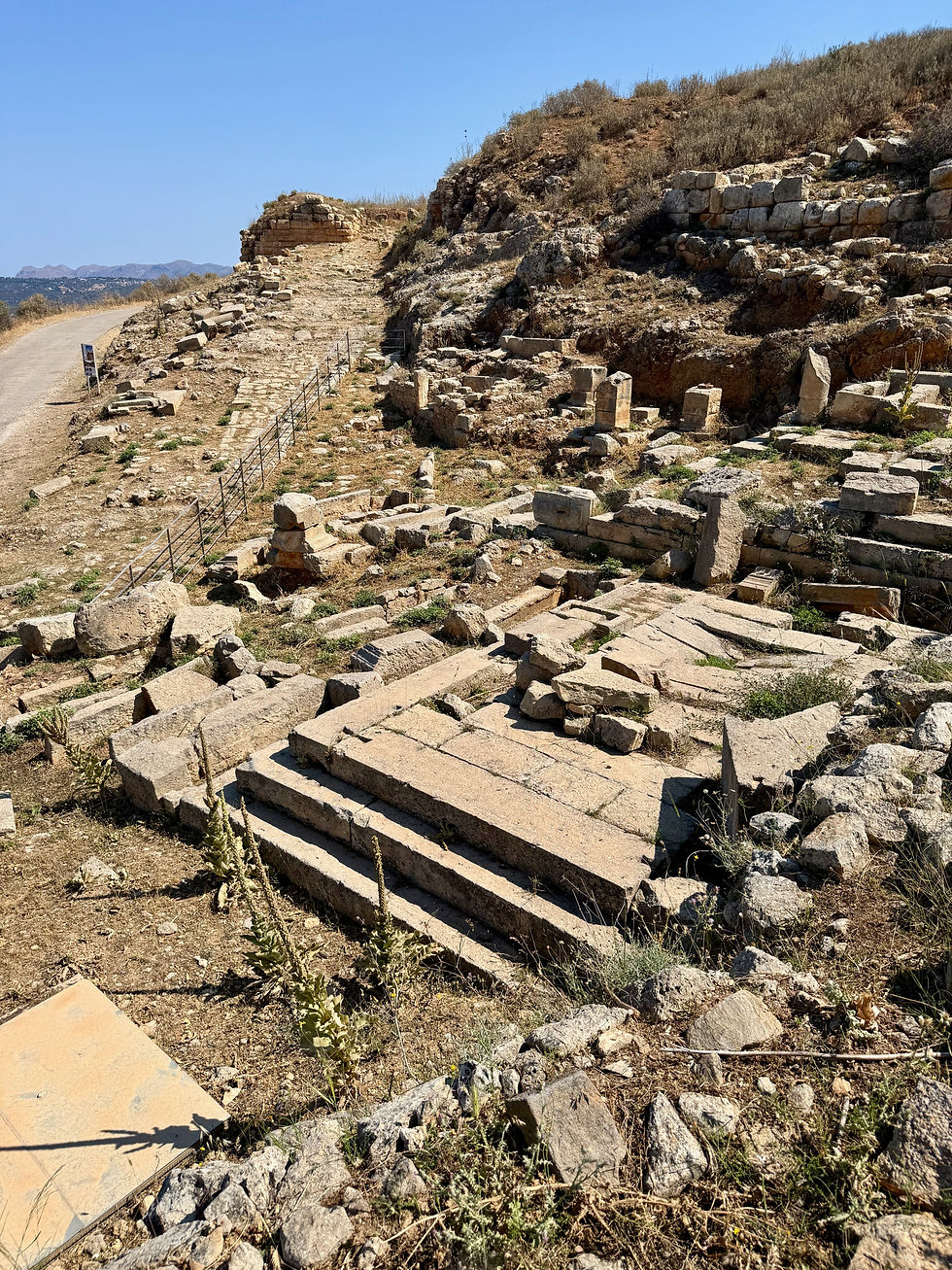
One of the most interesting places to stop is the area around the ancient main gate, just before you reach the main archaeological entrance.
The gate formed part of the fourth-century BC fortifications and was approached by a substantial paved road. You can still walk up this stretch of the road as it climbs towards the entrance to the city. It is about 3.5 metres wide and some of the ancient paving stones survive, together with the unmistakable ruts left by carts passing through the gateway.
The gate itself was protected by a large rectangular tower. Only the lower part survives today on the left as you look up towards the gateway, but it gives some idea of the imposing entrance that once confronted anyone approaching the city.
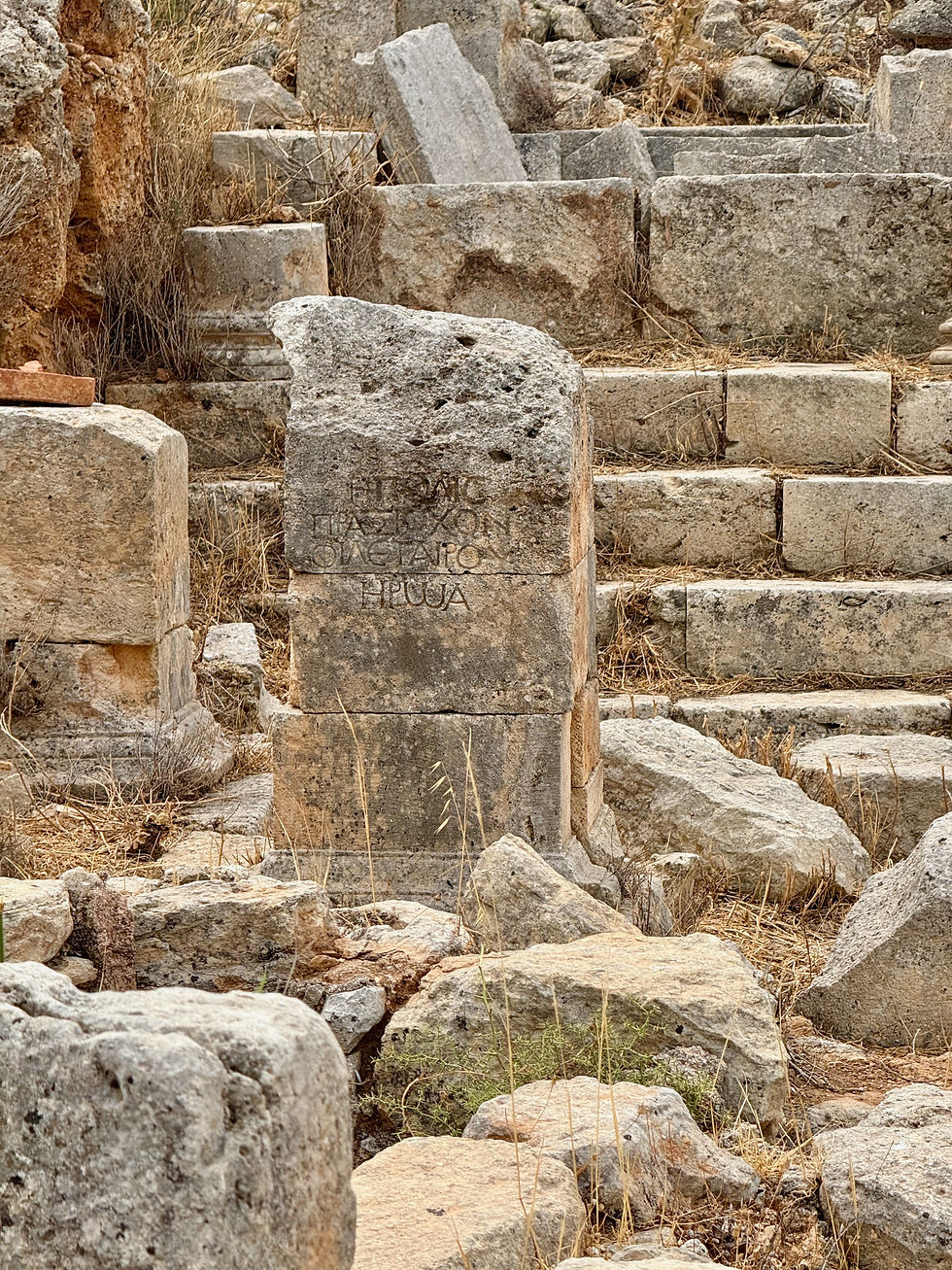
There is another reason to pause here. The approaches to ancient cities were often places of remembrance as well as movement. In the Roman world, burial within towns was generally forbidden, and tombs were commonly placed along the roads leading into and out of a settlement. These monuments could be surprisingly elaborate, deliberately putting the memory and status of the dead on display to everyone passing by.
At Aptera, the area around the ancient entrance continued to have a funerary significance. A heroon – a monument honouring an important individual – stood close to the road, alongside later funerary monuments. The result is a fascinating layering of functions: the same approach that once carried travellers and merchants into the city also became a place where the community remembered its dead.
Standing here today, with the ancient road disappearing uphill between the remains of the walls, it is possible to imagine how impressive this approach must once have been. Visitors to Aptera would have passed between the monumental defences and, later, the tombs and memorials of people who had played their part in the life of the city.
A City with a Very Long History
Aptera's history stretches back much further than the surviving stone buildings.
The earliest known reference to the name appears on Linear B tablets from Knossos, dating to the fourteenth or thirteenth century BC, where it appears as a-pa-ta-wa. This a-pa-ta-wa settlement was actually about 1.5km southwest of the present hilltop of Aptera, and was abandoned around 1190–1070 BC. The earliest traces of activity on the Aptera hilltop are attested by burials on the edge of the site dating to 1000 BC, and the Geometric period, around 700 BC. The city then developed into an important Cretan polis, or city-state, and by the Hellenistic period (late 4th–3rd century BC), Aptera had become wealthy and politically influential.
Aptera was famous for its archers, many of whom served as mercenaries. Cretan bowmen had a reputation across the ancient Mediterranean much as certain nations are known today for a particular military specialism, and Apteran archers were fighting far from home centuries before the city's Hellenistic-period wealth — Pausanias records them serving alongside the Spartans in the Second Messenian War as early as the 7th century BC. The city minted its own coins and maintained diplomatic relationships with other Cretan cities and with major powers elsewhere in the eastern Mediterranean.
During the third and second centuries BC, Aptera became involved in the complicated politics of Hellenistic Crete. Treaties and inscriptions demonstrate its connections with cities such as Eleutherna (central Crete, on the northern foothills of Mount Ida) and Hierapytna (predecessor of modern Ierapetra, on the south coast of Crete in the Lasithi region) and with larger powers including the Ptolemies of Egypt and the Attalids of Pergamon.
The city also found itself involved in warfare. During the Lyttian War — sometimes called the great Cretan War — of the late third century BC, Aptera had allied itself with the powerful city of Knossos. Polyrrhenia, backed by Philip V of Macedon and the Achaeans, laid siege to the city and forced it to abandon that alliance and switch sides.
Then came Rome.
Aptera had maintained close relations with the Romans and surrendered in 67 BC without suffering the destruction experienced by some other Cretan cities. Under Roman rule the city entered another period of prosperity, particularly during the first and second centuries AD. Public buildings were constructed, wealthy houses were remodelled and the theatre was transformed to meet Roman tastes.
The end came much later. A devastating earthquake in AD 365 caused widespread destruction, and although Aptera continued to be inhabited for several centuries, it never recovered its former importance.
The Theatre
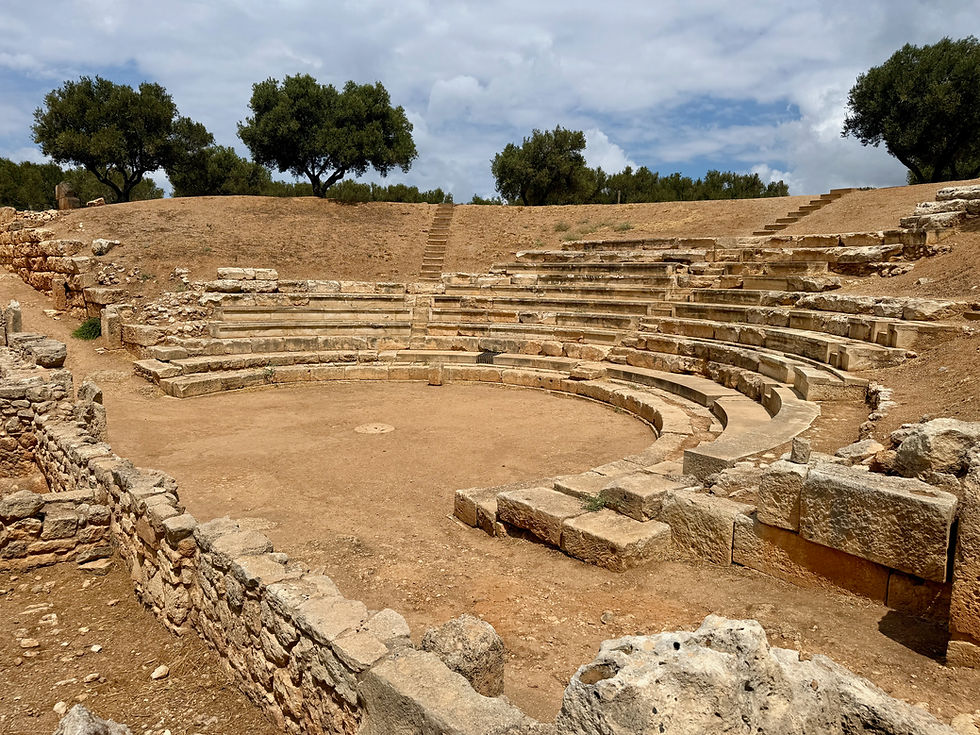
Once inside the archaeological site, one of the places I would recommend making a particular point of visiting is the ancient theatre.
The theatre occupies a natural hollow in the hillside and looks south towards the White Mountains. It was first constructed during the early Hellenistic period, probably in the first half of the third century BC. It was later remodelled during the Roman period, in the 1st century AD, and again in the 3rd century AD, when the seating, stage, and orchestra were altered.
The theatre is larger than it first appears. The cavea (seating area) is nearly 55 metres across and was divided into sections by stairways. The original seating has largely disappeared, partly because the stone was quarried for lime during the twentieth century, but the underlying structure remains remarkably clear.
One of the nicest features is the ancient paved road running beside the theatre. Around 50 metres of this Hellenistic road survives, and it once provided access to the theatre and other public buildings and sanctuaries nearby.
The theatre was excavated relatively recently, between 2008 and 2009, and subsequently conserved and restored. It is therefore one of the parts of Aptera where modern archaeological work has transformed what visitors can see.
Take a moment to look beyond the theatre itself. The view towards the White Mountains helps explain why the ancient inhabitants chose this location. The theatre was not tucked away in an isolated valley. It formed part of a substantial city occupying a prominent position above the surrounding landscape.
The Roman Peristyle Villa
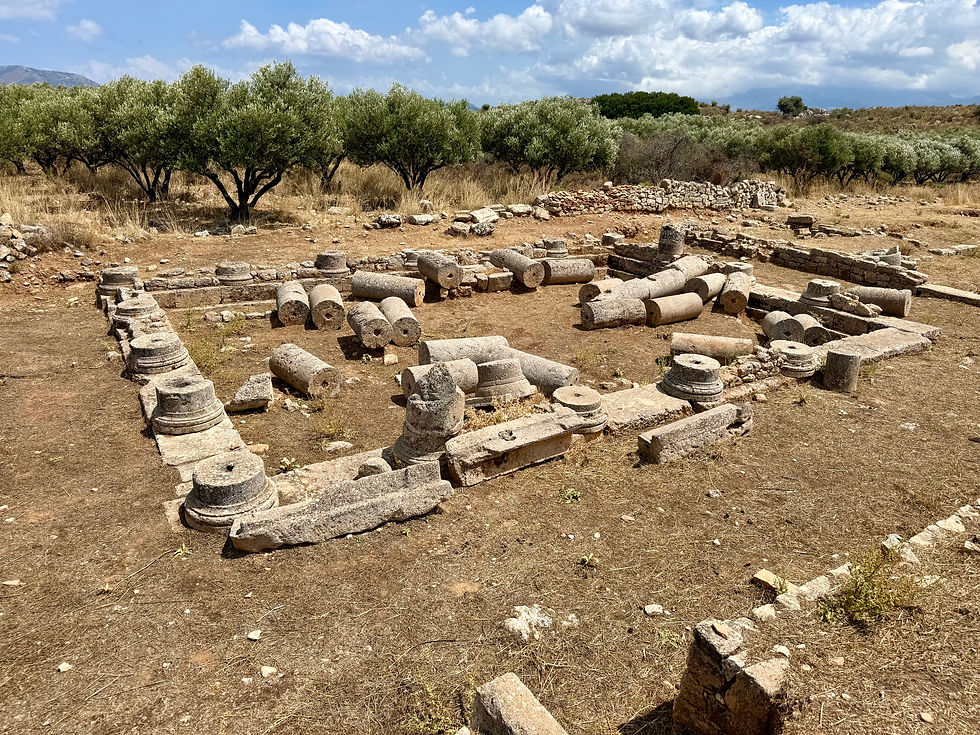
Not far from the theatre is one of the most intriguing buildings at Aptera: a large Roman villa belonging to what appears to have been a wealthy family.
Built during the first century AD, probably following the earthquake of AD 66, the villa covered a surprisingly large area. Its rooms were arranged around a central courtyard surrounded by a colonnade, or peristyle.
The columns are especially evocative. Ionic bases and Doric capitals once supported the covered walkway around the courtyard, which would have enclosed a garden. There were also small sculptures and a marble table, all suggesting that this area was an attractive domestic space, and not just a functional courtyard.
The villa also gives us an insight into everyday life. There was a household shrine, or lararium, near the entrance, while rooms opening onto the courtyard may have served as bedrooms and reception or dining rooms. A large cistern provided water, and an olive press and mortar found nearby suggest that parts of the villa were used for more practical activities during its later years.
Then, in AD 365, the earthquake struck.
The villa was destroyed and many of the columns and other architectural elements were left where they fell. This makes the remains exceptionally interesting because the destruction itself has helped archaeologists understand how the building looked and how it collapsed.
Excavation of the villa is still continuing, so this is very much a site where the archaeological story is still developing.
The Main Archaeological Site
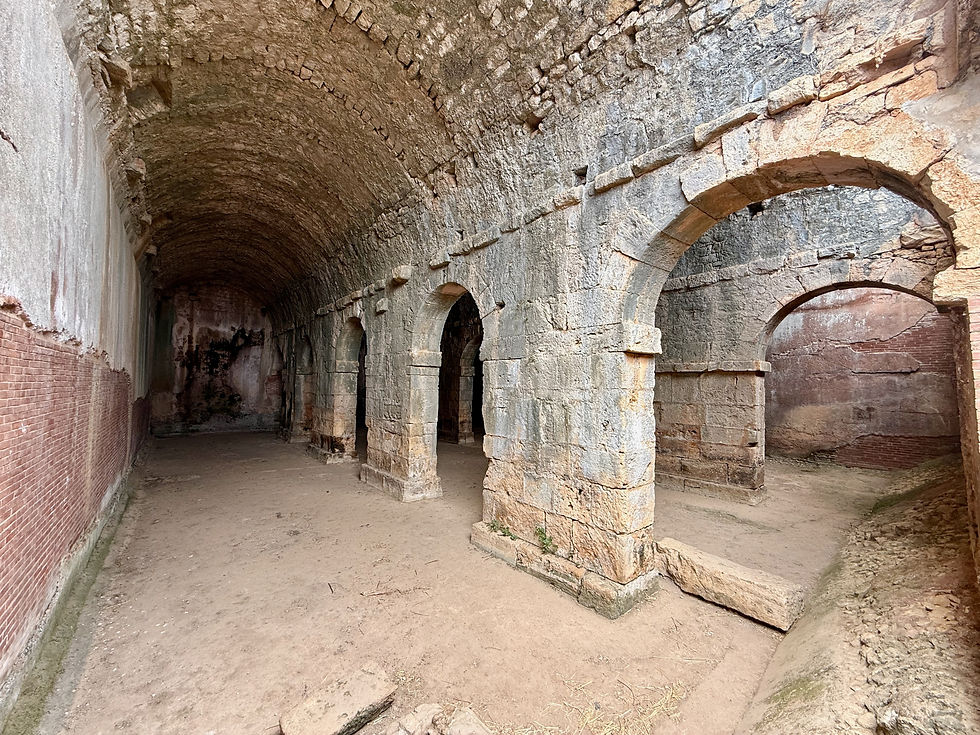
There is much more to see at Aptera than the theatre and Roman Peristyle Villa.
The excavated area contains substantial Roman baths, public buildings and temples, together with sections of the ancient fortifications. Water was particularly important here, because the hilltop had no springs or wells of its own — every drop had to be captured as rainwater and stored. The two great cisterns, with a combined capacity of almost 6,000 cubic metres, are consequently among the most impressive remains on the site.
There is also a small fifth-century BC temple and the remains of other religious and civic buildings. The so-called Wall of Inscriptions, discovered during the first excavations in the nineteenth century, contained honorary and diplomatic inscriptions which helped reveal the political importance of Aptera.
The later history of the hill is equally fascinating.
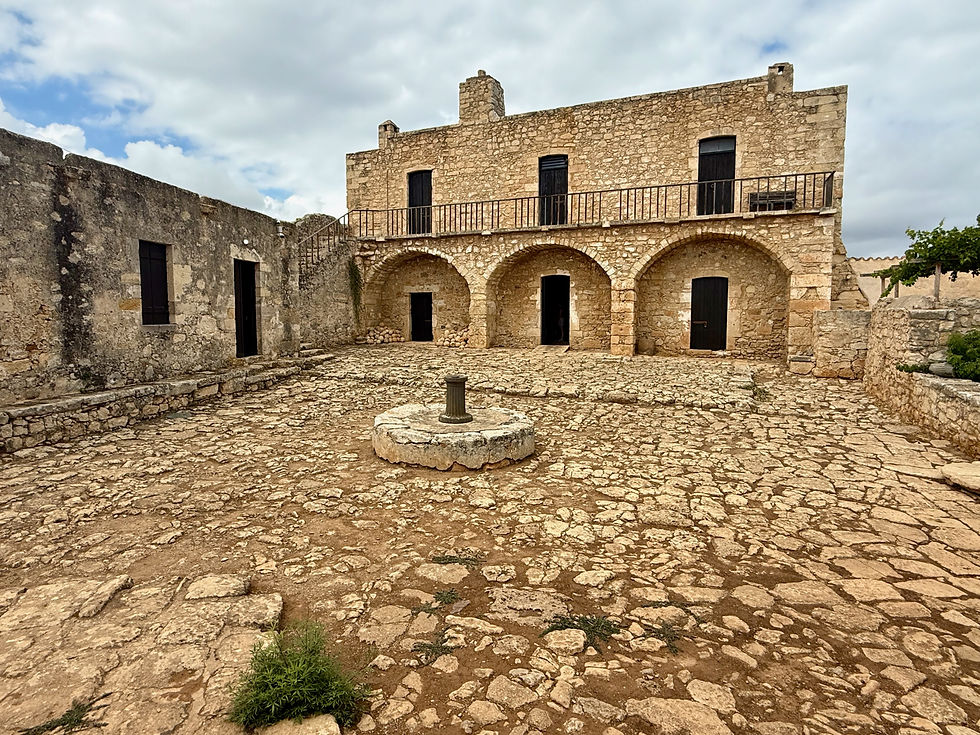
In the centre of the ancient city stands the former monastery of St John the Theologian, whose surviving buildings date mainly from the Venetian period. And on the higher ground is the much later Ottoman fortress known as Koules or Aptera Koule, constructed in the nineteenth century using stone taken from the ancient city.
It is an unusually good place to see different periods of Cretan history occupying the same landscape.
Visiting Aptera
Opening hours vary through the year — currently 08:00 to around 19:00 in late September, and changing every couple of weeks into autumn — so it's worth checking the official site before setting out. Entry is €10 (€5 reduced for students, teaching staff and over-65s), and the ticket also covers the Ottoman fortress on the hill above, so it's worth visiting both on the same trip.
Seeing the Finds
Much of what was actually found at Aptera isn't on the hill at all. The archaeological site shows you the setting — the walls, the theatre, the cisterns, the Roman Peristyle Villa — but many of the objects that once furnished this world are on display at the Archaeological Museum of Chania, in the city's Halepa district. Look out in particular for a marble statue of Apollo and a bronze statue of Artemis, both recovered from a household shrine in the Roman Peristyle Villa, and for the museum's collection of Apteran coins, which are considered some of the finest produced anywhere in Hellenistic Crete. If you're interested in the history rather than just the ruins, it's worth building the museum into your day — either on the way to Aptera or on the way back into Chania afterwards.
If Aptera is Closed
There is a useful little secret about visiting Aptera even outside opening hours. The ancient main gate and the surrounding fortifications can be seen from the road, and the remains of the Roman Peristyle Villa are also accessible from the area outside the main archaeological enclosure. So even when you cannot enter the ticketed site, you can still get a good impression of the ancient city and see some of its most atmospheric remains.
Of course, if the site is open, I would recommend going inside. The theatre, Roman Peristyle Villa, cisterns and public buildings make the entrance fee worthwhile, and the scale of the ancient city becomes much clearer once you are walking among the ruins.
A Visit from Villa Kourkoulios
Aptera is an easy trip from Villa Kourkoulios and can comfortably be combined with other places in the area, such as the Archaeological Museum of Chania.
We especially like the fact that it is not simply a single monument. You can begin with the ancient gate beside the road, walk through the remains of the city, sit for a while in the theatre and then spend time looking at the Roman Peristyle Villa and the enormous water cisterns.
Perhaps more than anything, Aptera gives you a sense of the landscape in which ancient Crete existed.
From the hilltop, you can look across the modern villages and olive groves towards Souda Bay and the White Mountains. It is difficult to look at that view without remembering that the same landscape was being watched by the inhabitants of Aptera more than two thousand years ago.
For anyone staying at Villa Kourkoulios with an interest in the history and archaeology of Crete, Aptera is one of those places that deserves more than a quick visit.
Visitor tip: If you have time, allow at least two hours for the archaeological site itself. Wear sensible shoes, take water in the hotter months and don't rush the theatre and Roman Peristyle Villa. And if you arrive to find the main gate closed, don't immediately turn around – stop at the ancient gate and Roman Peristyle Villa first. You can still see some remarkably evocative remains without entering the main site. There's nowhere to buy food or drink on site itself, but the modern village you drive through on the way up has three tavernas, perfect for a cold drink beforehand or a proper lunch once you're done.

Getting there: From Villa Kourkoulios, drive towards Vryses and join the national road towards Chania. Take the exit signposted for Aptera and Stilos and follow the signs uphill towards the archaeological site — you'll pass through the modern village of Aptera, with its three tavernas. The first site that you will come to is the Ancient Gate on your right, 450m before the parking for the main site. The journey is straightforward and takes around 30 minutes, depending on traffic and your exact route.

Comments