
Discovering Maza
Updated: Sep 24
Walking time from Villa Kourkoulios: approximately 14 minutes. Driving takes just 2 or 3 minutes.
Just a short walk from Villa Kourkoulios is the small village of Maza. The walk is easy, following a gentle incline before dropping slightly into the village. The road is flanked by olive groves on one side and woodland on the other, offering welcome shade for much of the route. It makes an easy walk for a lovely evening out in Maza. Look out for the yellow-flowered Jerusalem Sage that grows prolifically along the roadside. Despite its name and appearance, it is actually a member of the mint family and has traditionally been used in herbal medicine.
The Village of Maza
At first glance Maza looks much like many other villages in Apokoronas, but spend a little time here and you’ll discover one of the finest medieval churches in western Crete, together with a history stretching back at least seven centuries.
Although Maza is becoming an increasingly popular base for visitors exploring Apokoronas, it remains a traditional Cretan village set within a landscape that has attracted settlement for generations. The village sits on a gentle hillside overlooking fertile farmland, close to natural water sources and on routes linking Vryses, Stylos and Alikampos. Unlike many Cretan villages that developed in more defensive mountain locations, Maza appears to have prospered because of the quality of its agricultural land. Olive groves, vineyards and cereal fields have shaped the surrounding landscape for centuries and continue to do so today.
The origin of the village’s name is uncertain. One possibility links it to the ancient Greek word maza, meaning a barley loaf or cake, perhaps reflecting the area’s agricultural past. Another suggestion is that it preserves the name of an early estate or family. Like many Cretan place names, its true origin has been lost, leaving several possible explanations rather than one accepted answer.
Although Maza is certainly older, it begins to emerge clearly from the historical record during the Venetian period. The earliest surviving written reference comes from the Church of Agios Nikolaos itself. An inscription painted inside the church in 1325–26 refers to “Saint Nicholas of Maza”, showing that the settlement was already well established by the early fourteenth century.
Two centuries later, the Venetian historian Francesco Barozzi recorded the village as Masa in 1577, while Pietro Castrofilaca listed it as Maxa in his survey of 1583. By the early seventeenth century, Francesco Basilicata referred to the settlement as Masa Alicambo, linking it with the wider district around Alikampos. Although the spelling changed from one document to another, the village itself remained much the same – a small farming community surrounded by fertile land.
The Church of Agios Nikolaos
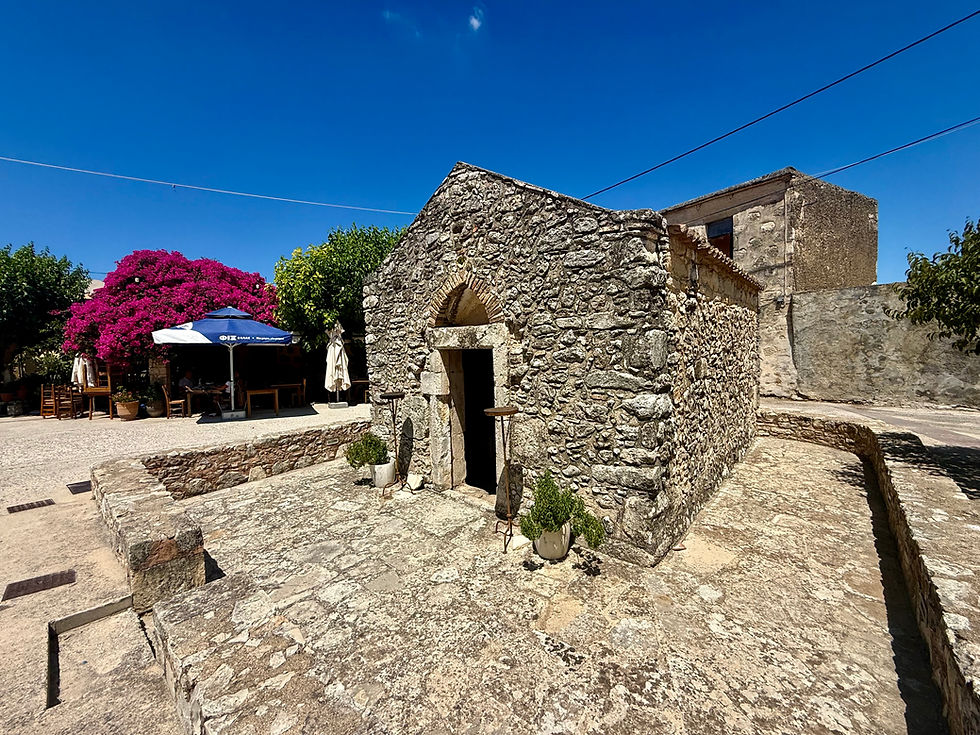
The Church of Agios Nikolaos (St Nicholas) is the main reason many visitors come to Maza. From the outside it is a simple single-nave church built from local stone. Its modest appearance gives little indication of what lies inside. Step through the doorway, however, and almost every wall is covered with frescoes dating from 1325–26. They are widely regarded as some of the finest surviving examples of Byzantine wall painting in western Crete.
The paintings were completed by Ioannis Pagomenos, one of the leading church painters working in Crete during the fourteenth century. His work survives in several churches across western Crete, including the Church of the Dormition (Panagia) at nearby Alikampos, painted about a decade earlier, together with churches at Komitades, Anydroi and Moni. Maza is generally considered to be one of his finest surviving works.

The frescoes depict scenes from the life of Christ alongside saints, bishops, prophets and warrior martyrs. They were intended not simply as decoration but as a way of teaching and reinforcing the Christian faith at a time when most people could not read. Even after almost seven hundred years, many of the colours remain remarkably well preserved.
One of the most interesting features of the church is the painted inscription recording who commissioned the work. Pagomenos included not only his own name but also those who paid for the decoration. Among those listed are Father Michael together with villagers including Demetrios Sarakinopoulos, Konstantinos Raptis, Konstantinos Sarakinopoulos and Georgios Mauromatis. Rather than attempting to name every donor, the inscription concludes with the words:
”…and all the people of the village of Maza, whose names are known to the Lord.”
It is a small detail, but one that brings the medieval village unexpectedly close. This was not a church decorated by a wealthy nobleman or monastery. It appears to have been a project supported by the whole community.
Local tradition says that Ioannis Pagomenos himself was buried beneath the floor of the church. There is no archaeological evidence to confirm this, but it reflects the respect in which both the artist and his work have long been held.

As you exit the church, take a moment to look above the entrance on the outside. Set into the stonework are two glazed ceramic bowls: one above the doorway and another high on the eastern apse. These are not later additions but part of the church's original medieval design. Known by the Italian name bacini, glazed bowls were built into churches across parts of the Byzantine and Venetian Mediterranean. Recent research suggests that, in Crete, these ceramic bowls were carefully selected and deliberately positioned during construction, with their arrangement and decoration conveying symbolic and religious meaning as well as providing colourful decoration. They enlivened otherwise plain stone buildings and reflected the artistic influences and imported ceramics that reached Crete through Mediterranean trade. Today, Crete preserves one of the largest surviving collections of these remarkable architectural features.
Although Maza is best known for Agios Nikolaos, it forms part of a remarkable concentration of historic villages in this part of Apokoronas. Nearby Alikampos contains another church painted by Pagomenos, while Stylos, Vryses and the tiny hamlet of Champatha – home to Villa Kourkoulios – all preserve reminders of the region’s Byzantine and Venetian past. Together they tell the story of a prosperous rural landscape whose wealth came from farming rather than from castles or cities.
Our Favourite Taverna
After visiting the church, take time to wander through the village. Across the village square from the church is Kostas’ traditional taverna, Maza Cafeneion. This is an excellent place to stop for a coffee, lunch or dinner.
Kostas is likely to greet you with the warm welcome for which Cretans are famous. There is no menu, but Kostas or another member of his family will explain what is being cooked that day and help you choose. If the evening is busy, you’ll see the taverna slowly spread out into the square, and before long you’ll find yourself watching everyday Cretan life unfold around you.
On another side of the square is the Klapas Family Shop, selling a range of locally grown herbs, mountain tea and other Cretan products. It is well worth a few minutes before enjoying the short walk back to Villa Kourkoulios.
For many visitors, Maza becomes somewhere they return to more than once during their stay, if only to visit Kostas and his taverna. The history may bring you here for the first time, but the village itself is usually the reason you come back.
Visitor tip: The church is not always open, but it is still worth visiting for its beautiful setting and unusual architectural details. If you do find it open, spend a few minutes looking not only at the frescoes but also at the ceramic bowls set into the exterior walls before rewarding yourself with a coffee, lunch or dinner at Kostas’ taverna.
Sources
Historical records: Francesco Barozzi (1577); Census of Kastrofylakas (1583); Francesco Basilicata (1630); Egyptian Census of Crete (1834).
Local history and place names: Stergios Spanakis, Πόλεις και Χωριά της Κρήτης (Cities and Villages of Crete); Municipality of Apokoronas, Getting to Know the Villages of Apokoronas.
Church of Agios Nikolaos: Studies of the church and its 1325 frescoes by Ioannis Pagomenos; Greek Ministry of Culture records; Municipality of Apokoronas.
Archaeology: Published archaeological reports on the wider Apokoronas region; Greek Ministry of Culture archaeological records.

Comments